
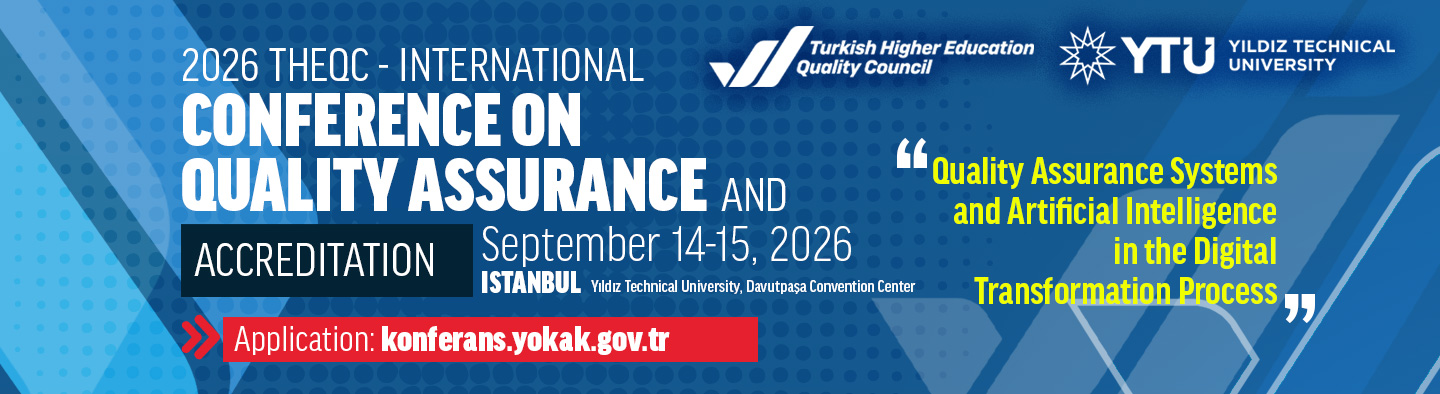
2nd THEQC International Conference on Quality Assurance and Accreditation
“Quality Assurance Systems and Artificial Intelligence in the Digital Transformation Process”
Call for Papers
The 2nd THEQC International Conference on Quality Assurance and Accreditation will be convened on September 14–15, 2026 at Yıldız Technical University, Istanbul. The conference aims to provide a distinguished international forum for scholarly dialogue on the evolving architectures of quality assurance in higher education, particularly in the context of digital transformation, artificial intelligence, and global governance dynamics.
The 2026 conference will focus on the conceptual and operational redesign of quality assurance systems, including AI-supported quality policies, data-informed decision-making mechanisms, digital quality assurance platforms, learning analytics, and performance monitoring systems. Particular attention will be given to emerging governance models and to the ethical, transparent, and human-centred integration of artificial intelligence into quality assurance processes, with emphasis on accountability, explainability, data protection, academic integrity, and algorithmic bias.
From an international perspective, the conference will address quality assurance in cross-border higher education, joint and dual degree programs, micro-credentials and lifelong learning, and comparative analyses of global quality standards and recognition frameworks. These discussions aim to contribute to a deeper understanding of quality assurance as a strategic and integrative component of institutional sustainability and academic excellence.
The conference builds upon the scholarly success of the 2024 THEQC International Conference on Quality Assurance and Accreditation, which attracted 155 paper submissions, of which 58 papers were accepted following a rigorous peer-review process. Selected contributions were subsequently published in a special issue of the TÜBA-HER Journal of Higher Education, an ESCI-indexed journal published by the Turkish Academy of Sciences, underscoring the conference’s growing academic impact and international visibility.
The overarching objective of the 2026 conference is to advance quality assurance beyond evaluative practices, positioning it as a holistic, learning-oriented, and trust-based governance system that supports institutional development and long-term resilience. Academics, researchers, policymakers, accreditation professionals, and higher education stakeholders are cordially invited to submit original research papers, theoretical analyses, and evidence-based institutional practices.
English and Turkish are the official languages of the conference.
Abstract submission is free of charge.
Main Themes
AI-Supported Quality Assurance Policies
This theme focuses on the transformation of quality assurance policies in higher education through artificial intelligence and digital governance frameworks, addressing data-driven decision-making, AI-supported policy design, institutional leadership, change management, and the integration of internal quality assurance systems that align institutional strategy, processes, and data management, while fostering continuous improvement cycles and a sustainable quality culture.
AI-Supported Institutional Performance Measurement and Monitoring Systems
This theme examines the development and implementation of AI-enabled performance measurement and monitoring systems, including digital quality assurance platforms, learning analytics, smart campus indicators, big data-based early warning mechanisms, and standardized quality dashboards, with an emphasis on institutional accountability, transparency, and evidence-based decision-making.
Internationalization and Global Quality Assurance Systems
This theme explores quality assurance in an increasingly global and digital higher education ecosystem, focusing on cross-border education, international accreditation standards, AI-supported diploma recognition systems, digital credentials, joint and dual degree programs, micro-credentials, lifelong learning pathways, and comparative analyses of global quality assurance policies aimed at strengthening trust and recognition mechanisms.
Ethical and Secure Use of Artificial Intelligence in Quality Assurance Systems
This theme addresses the ethical, legal, and governance challenges arising from the use of artificial intelligence in quality assurance systems, including transparency and explainability, data privacy and security, academic integrity, human-centred AI governance, and the management of algorithmic bias, fairness, accountability, and model auditability throughout the quality assurance lifecycle.
Future of Quality Assurance Systems and Innovative Approaches
This theme focuses on forward-looking perspectives and innovative models of quality assurance in the age of artificial intelligence, examining sustainable and inclusive digital quality systems, future university models, emerging learning environments, AI-supported program design and accreditation processes, and the digitalisation of external quality assurance methodologies, peer review systems, monitoring mechanisms, and complaint and appeal processes.
Other Relevant Topics in Quality Assurance and Higher Education
In addition to the main thematic streams, the conference welcomes contributions addressing other relevant and emerging topics related to quality assurance, accreditation, governance, policy development, and innovation in higher education. Regular sessions are intended to provide a flexible academic space for scholarly work that extends beyond the defined themes while remaining aligned with the overall scope and objectives of the conference.
Important Dates:
Abstract Submission Opens:
February 5, 2026
Abstract Submission Deadline:
April 30, 2026
Abstract Acceptance Notification:
May 15, 2026
Full Paper Submission Deadline:
July 30, 2026
Full Paper Acceptance Notification:
August 15, 2026
Final Paper Submission:
August 28, 2026
Conference Dates:
September 14–15, 2026
KEYNOTE SPEAKERS

Prof. Dr. Bjørn Stensaker
President of EQAR, Professor of Higher Education at University of Oslo, Research Professor at NIFU The Nordic Institute for Studies in Innovation Education and Research

Jamil Salmi
Emeritus Professor of Higher Education Policy at Diego Portales University, Research Fellow at Boston College’s Center for Higher Education
Conference Committees
Honorary Committees
Professor Ümit KOCABIÇAK, President of THEQC
Professor Eyüp DEBİK, Rector of Yıldız Technical University
Chairman of the Organizing Committees
Ramazan BAYINDIR, Vice President of THEQC
Vatan KARAKAYA, Vice Rector of Yıldız Technical University
Sema YILMAZ, Council Member of THEQC
Advisory Boards
Ali BİLGİN, Council Member of THEQC
Mustafa Sıtkı BİLGİN, Council Member of THEQC
Elif ÇEPNİ, Council Member of THEQC
Hüseyin AĞIR, Council Member of THEQC
Mesut GÜNER, Council Member of THEQC
Murat SARĞIN, Council Member of THEQC
Aşkın TÖREN, Council Member of THEQC
Gülden Banu MÜDERRİSOĞLU, Council Member of THEQC
Cengiz DELİBAŞ, Council Member of THEQC
Fatma Derya ARIKAN, Council Member of THEQC
Organizing Committees
Mehmet YILMAZ, Secretary General of THEQC
Yunus Nadi YÜKSEK, Advisor to the President of THEQC
Resul TELLİ, Advisor to the President of THEQC
Levent ALTINTAŞ, Advisor to the President of THEQC
Songül VARGÜN, Advisor to the President of THEQC
Çiğdem SAZAK TURGUT, Advisor to the President of THEQC
Meryem Ayşegül KOZAK ÇAKIR, Advisor to the President of THEQC
Mustafa ÇOLAK, Advisor to the President of THEQC
Sena ÇATAL, Advisor of THEQC
Ömer Faruk YILDIZ, Branch Manager of THEQC
Aykut BÖCÜKCÜ, Assistant Expert of THEQC
Muzaffer Mert TOPUZ, Assistant Expert of THEQC
Mustafa ÖZCAN, Assistant Expert of THEQCHans de WIT, Boston College, USA
Scientific Committees
Philip G. ALTBACH, Boston College, USA
Chan BASARUDDIN, University of Indonesia, Indonesia
Eltjo BAZEN, EQAR – European Quality Assurance Register, Netherlands
Brandford BERVELL, University of Cape Coast, Ghana
Chané de BRUYN, University of Johannesburg, South Africa
Hamish COATES, Australian National University, Australia
Clifton CONRAD, University of Wisconsin–Madison, USA
Gwilym CROUCHER, University of Melbourne, Australia
Anca GREEREG, Babes-Bolyai University, Romania
Rima ISAIFAN, Georgetown University, Qatar
Terri KIM, Hanyang University, South Korea
Manja KLEMENČIČ, University of Ljubljana, Slovania
Simona LACHE, Transilvania University of Brașov, Romania
Theodor LEIBER, University of Augsburg, Germany
Luis LOURES, Portalegre Polytechnic University, Portugal
Liviu MATEI, King’s College London, UK
Sélim MEKDESSI, Lebanese University, Lebanon
Ka Ho MOK, The Hang Seng University of Hong Kong, Hong Kong
Teboho MOJA, New York University, USA
Anatoly V. OLEKSIYENKO, The Education University of Hong Kong, Hong Kong
Francesc PEDRÓ, Universitat Pompeu Fabra, Spain
Fabricio Pelloso PIURCOSKY, Centro Universitário Integrado, Brazil
Jana PRODANOVA, Macedonian Academy of Sciences and Arts, Macedonia
Juliana Elisa RAFFAGHELLI, Università degli Studi di Padova, Italy
Manuel SALAS-VELASCO, University of Granada, Spain
Fabrizio TRIFIRÒ, Times Higher Education, INQAAHE, UK
N. V. VARGHESE, Indian Institute of Technology Bombay, India
Shen WENQIN, Peking University, China
Hans de WIT, Boston College, USA
Abstract Submission Guidelines
Paper Writing Rules
The title should not contain more than 15 words.
The abstract should not exceed 250 words. Abstracts longer than this limit may be rejected during the editorial pre-evaluation process, as excessive detail at the abstract stage may compromise the originality and confidentiality of the full paper.
Keywords should be written in lowercase, and a maximum of five (5) keywords should be provided.
English Title, Abstract, and Keywords for applications in Turkish will be requested, if accepted.
Abstract
The abstract should concisely present the background and purpose of the study, the methodological approach, the main findings, the practical implications, and the conclusion.
Introduction
The introduction should clearly present the rationale, background, and significance of the study based on relevant literature. At the end of the introduction, the purpose, scope, and research questions or problems of the study must be explicitly defined.
Methodology
The section should describe the research design or model, participants or data sources (such as documents, datasets, or research environments), data collection procedures, data analysis techniques, and evidence of validity and reliability (or trustworthiness and rigor for qualitative studies).
Findings
The findings should be reported systematically, aligned with the research questions or sub-problems, and presented in accordance with scientific writing principles, without interpretation or discussion beyond the reported results.
Discussion
The discussion section should interpret the findings in relation to the existing literature, highlight theoretical and/or practical implications, and critically assess similarities, differences, and contributions relative to prior studies with citations.
Conclusion
The conclusion should clearly summarize the main outcomes of the study in line with its stated purpose and research questions, without introducing new data or arguments. Implications, limitations, and directions for future research should be briefly addressed.
References
All sources cited in the manuscript should be listed in the references section.
Notes
The current APA (7th edition) format must be strictly followed for all references, tables, and figures.
The total length of the manuscript should not exceed 4,000 words, including the title, abstract, keywords, introduction, methodology, findings, discussion, conclusion, and references.
Ethical Agreement
Researchers acknowledge and declare that their research is carried out in accordance with the Principles of Scientific Research Ethics, that personal and institutional data, if any, are used with the consent of the parties and for the stated purposes, and that some or all of the study has not been presented or published.
The authors/speakers further declare that the submitted work has not been simultaneously submitted to another conference, journal, or publication process, and that it does not constitute duplicate publication or self-plagiarism. In the case of an extended or revised version of a previously presented work, this must be explicitly stated and properly referenced.
The accuracy, originality, ethical compliance, and legal conformity of all information, data, analyses, and statements contained in the submission are the sole responsibility of the author(s)/speaker(s). Any ethical, scientific, legal, or administrative consequences arising from violations of these principles shall rest exclusively with the author(s)/speaker(s).
By submitting an abstract and/or full paper to the conference, the author(s)/speaker(s) explicitly acknowledge that Turkish Higher Education Quality Council (THEQC) shall not be held responsible for any ethical misconduct, misrepresentation, or legal dispute related to the content of the submission.
Policy on the Use of Artificial Intelligence
The use of generative artificial intelligence (AI) tools is limited exclusively to language enhancement, grammar correction, and editorial assistance. AI tools shall not be used to generate scientific arguments, interpret results, create figures, tables, or visual materials, develop research models or methodologies, perform data analysis, or produce original research content.
For the avoidance of doubt, any use of AI tools beyond linguistic and editorial support shall be considered a violation of this policy and evaluated as an ethical breach.
AI tools cannot be credited as authors under any circumstances. Authors are fully accountable for the content of their submissions, including any ethical, scientific, or legal issues arising from the use or misuse of AI tools.
If AI tools are used in any part of the manuscript preparation, this must be clearly disclosed in the Acknowledgements or Methods section, explicitly specifying the name of the tool, the scope of use, and the purpose of use.
Any use of AI tools must be explicitly declared in the manuscript. Failure to disclose AI usage, incomplete disclosure, or misrepresentation of the scope of AI use may result in rejection of the submission, withdrawal from the evaluation process, removal from the conference program, and/or exclusion from publication.
In cases where undisclosed or improper use of AI tools is identified after acceptance, presentation, or publication, THEQC reserves the right to unilaterally withdraw the paper, remove it from all publication platforms, and take further action deemed necessary. All consequences arising from such actions shall be borne solely by the author(s)/speaker(s), and THEQC shall not be held liable under any circumstances.
Processing of Personal Data
THEQC pays particular attention to ensuring the confidentiality and security of information belonging to its users. This issue is a requirement of THEQC's sensitivity on this matter and an obligation in accordance with the relevant legal legislation (Law No. 6698 on the Protection of Personal Data). Within the framework of THEQC's approach to protecting participant information and ensuring full compliance with legal regulations, explicit consent is hereby requested by accepting the following terms:
a) Your personal information, the meeting(s) you attend, and the abstract(s) and paper(s) you submit may be collected, recorded, stored, and processed by THEQC in corporate local and/or cloud-based information systems,
b) If you attend the Conference, audio and/or video recordings of the meeting(s) you attend may be recorded by THEQC in corporate local and/or cloud-based systems,
c) These records may be accessed and used by authorized persons for scientific evaluation, reporting, archiving, accreditation-related activities, and process improvement purposes, within the scope of the official meeting invitation communicated to you by letter and/or e-mail, and
d) Images, recordings, and visual materials representing the Conference and its activities may be used on THEQC's website, social media channels, official reports, and publications for institutional communication, dissemination, and archival purposes.
By accepting this agreement, you expressly declare that you have been informed about the scope and purpose of personal data processing and that you provide your explicit consent accordingly.
All information, including the personal data of our users, shall not be shared with third parties in any manner or form without the explicit consent of the data subject, except for legal institutions and authorities authorized to access such information pursuant to applicable legislation.
THEQC ensures that institutions and service providers from which it receives support services comply with THEQC’s confidentiality, data security, and personal data protection standards.
In this respect, protecting all data relating to THEQC and its users from unauthorized access, unlawful processing, misuse, alteration, corruption, loss, or destruction, and ensuring the confidentiality, integrity, and availability of data constitute THEQC's primary approach.
Data subjects retain the right to withdraw their explicit consent at any time in accordance with Law No. 6698. Withdrawal of consent shall not affect the lawfulness of processing carried out prior to such withdrawal.
THEQC shall not be held liable for any claims, damages, or disputes arising from the processing of personal data carried out in compliance with this policy and applicable legislation. Any legal responsibility arising from inaccurate, misleading, or unlawful information provided by participants shall rest solely with the relevant author(s)/speaker(s).
THEQC establishes detailed internal regulations in this regard and meticulously considers the protection of user data across all practices and processes.
Peer Review and Editorial Processes
Abstracts and full papers submitted to the Conference are subject to peer review and editorial evaluation processes conducted in accordance with the scientific and ethical criteria determined by THEQC. The scope, method, and implementation of the evaluation process are entirely at the discretion of THEQC.
The peer review process may be conducted, where deemed appropriate, in the form of single-blind review, double-blind review, or editorial pre-evaluation. Reviewers are appointed by THEQC from among individuals with relevant academic and professional expertise. Reviewer opinions are advisory in nature, and final decision-making authority rests exclusively with THEQC.
The author(s)/speaker(s) acknowledge and accept that the peer review process does not constitute any guarantee of acceptance, presentation, or publication, and that their submissions may be rejected, returned for revision, or excluded from the evaluation process based on reviewer and/or editorial assessments.
Within the scope of the editorial process, THEQC reserves the right to examine and evaluate:
- the scientific adequacy of the submission,
- compliance with ethical principles,
- the accuracy and completeness of declarations regarding the use of artificial intelligence,
- risks of plagiarism and self-plagiarism,
- compliance with applicable legislation and conference rules.
The responsibility for completing any revisions requested during the peer review and editorial evaluation process within the specified timeframe and scope lies solely with the author(s)/speaker(s). Revisions that are not submitted on time or are deemed insufficient may result in rejection of the submission or removal from the evaluation process, for which THEQC shall bear no responsibility.
The author(s)/speaker(s) acknowledge and declare that, with respect to the peer review process:
- they shall not request the disclosure of reviewer identities,
- the right to object to reviewer reports may be restricted or entirely closed at the discretion of THEQC, and
- editorial decisions are final and binding.
If, after completion of the evaluation process or following acceptance or publication, ethical violations, scientific misconduct, false or misleading statements, non-compliance with regulations governing the use of artificial intelligence, or violations of applicable legislation are identified, THEQC reserves the right to unilaterally withdraw the paper, remove it from publication, exclude it from the conference program, and, where deemed necessary, notify the relevant institutions and authorities.
No differences of opinion, delays, or outcomes arising from the peer review or editorial evaluation processes shall give rise to any right, claim, objection, or compensation demand against THEQC. All risks and consequences associated with these processes are borne solely by the author(s)/speaker(s).
Submission of an abstract and/or full paper to the Conference and/or participation in the Conference constitutes explicit acknowledgment and acceptance that all provisions governing the peer review and editorial processes have been read, understood, and agreed to.
Full Paper and Abstract Publication Process
Abstracts and full papers submitted to the Conference are subject to scientific, ethical, and editorial evaluation processes. These processes are conducted in accordance with the procedures and principles determined by THEQC. The author(s)/speaker(s) acknowledge and accept that the submission of an abstract and/or full paper for evaluation does not constitute any guarantee of acceptance, presentation, or publication.
All responsibility for the scientific content, originality, compliance with ethical principles, conformity with applicable legislation, and adherence to the declared rules of the submitted abstracts and full papers rests exclusively with the author(s)/speaker(s). In this context, THEQC shall not be held liable under any circumstances for any ethical, scientific, legal, or administrative consequences arising from the content of the submissions.
Abstracts and/or full papers that are accepted following the evaluation process may be published by THEQC in electronic and/or printed formats deemed appropriate, including but not limited to conference proceedings, the conference website, institutional digital archives, open-access platforms, and similar media. The author(s)/speaker(s) acknowledge and declare that they grant an irrevocable, unrestricted, and non-exclusive permission, without any limitation as to time, scope, or medium, for the publication and dissemination of their abstracts and/or full papers in these outlets.
THEQC reserves the right, at its sole discretion and without any obligation to provide justification, to decide on any of the following:
- publication of abstracts only,
- non-publication of full papers,
- publication of an extended abstract in place of the full paper,
- complete withdrawal of a paper from publication or non-publication, even if it has previously been accepted.
If, at any stage following the evaluation process or after publication, ethical violations, scientific misconduct, incomplete, inaccurate, or misleading declarations regarding the use of artificial intelligence, plagiarism, self-plagiarism, non-compliance with legislation, or submission of false or misleading information or documentation are identified, THEQC reserves the right to remove the paper from the conference program, withdraw it from publication, delete it from the proceedings and institutional digital archives, and, where deemed necessary, notify the relevant institutions and authorities. Any and all consequences, sanctions, and legal liabilities arising from such actions shall rest solely with the author(s)/speaker(s).
By submitting an abstract and/or full paper to the Conference and/or by participating in the Conference, the author(s)/speaker(s) expressly acknowledge and declare that the exclusive authority to decide on the publication or non-publication of their submissions lies with THEQC, and that they shall not assert any rights, claims, objections, or compensation demands in this regard.
For matters requiring clarification regarding these terms and conditions, please submit your request via e-mail to theqcsecretariat@yokak.gov.tr.
TRANSPORT
As part of our international congress, we are pleased to provide transportation information for participants arriving at Sabiha Gökçen International Airport and traveling to the congress venue at Yıldız Technical University, Davutpaşa Congress Center.
Venue Address:
Çifte Havuzlar Mahallesi, 34220 Esenler, Istanbul, Türkiye
Transportation from Sabiha Gökçen International Airport (SAW)
The congress venue is located on the European side of Istanbul, while Sabiha Gökçen Airport is on the Asian side.
1️ Metro + Marmaray + Metro (Recommended – Fast & Traffic-Free)
This is the most reliable option, especially during peak traffic hours.
- Take the M4 Metro Line (Kadıköy–Tavşantepe) from the airport to Ayrılık Çeşmesi station.
- Transfer to the Marmaray line and travel to Yenikapı station (European side).
- At Yenikapı, transfer to the M1A Metro Line (Yenikapı–Atatürk Airport direction) and get off at Davutpaşa–YTÜ station.
- From the station, follow the signs to Davutpaşa Campus and the Congress Center (approximately 5–10 minutes walking distance).
Estimated travel time: 75–90 minutes
Note: An Istanbulkart is required for public transportation (available at the airport).
2️ Airport Shuttle (Havabus) + Metro
- Take the Havabus airport shuttle to either Taksim or Kadıköy.
- From Taksim: Use metro connections to reach Yenikapı, then take the M1A line to Davutpaşa–YTÜ station.
- From Kadıköy: Take Marmaray to Yenikapı and transfer to the M1A line.
Estimated travel time: 90–120 minutes (depending on traffic conditions).
3️ Taxi or Private Transfer (Direct & Comfortable)
Taxis are available 24/7 at the airport. You may also arrange a private airport transfer in advance.
Please provide the following destination to the driver:
Yıldız Technical University – Davutpaşa Campus, Davutpaşa Congress Center (Esenler)
Estimated travel time: 50–80 minutes (depending on traffic).
Fare: Varies according to traffic and time of day.
Transportation from Istanbul Airport (IST)
The congress venue is located on the European side of Istanbul.
1️ Metro (Recommended – Fast & Traffic-Free)
The metro is the most efficient and reliable option, particularly during peak traffic hours.
- Take the M11 Metro Line (Istanbul Airport–Gayrettepe) from the airport.
- At Gayrettepe station, transfer to the M2 Metro Line (Yenikapı direction).
- Get off at Yenikapı station.
- Transfer to the M1A Metro Line (Atatürk Airport direction) and get off at Davutpaşa–YTÜ station.
- From the station, follow the signs to Davutpaşa Campus and the Congress Center (approximately 5–10 minutes walking distance).
Estimated travel time: 60–75 minutes
Note: An Istanbulkart is required for public transportation (available at the airport).
2️ Airport Shuttle (Havaist) + Metro
- Take a Havaist airport shuttle from Istanbul Airport to a central location such as Taksim or Aksaray.
- From Taksim: Use metro connections to reach Yenikapı, then take the M1A line to Davutpaşa–YTÜ station.
- From Aksaray: You may directly access the M1A metro line and travel to Davutpaşa–YTÜ station.
Estimated travel time: 70–100 minutes (depending on traffic conditions).
3️ Taxi or Private Transfer (Direct & Comfortable)
Taxis are available 24/7 outside the arrivals terminal. Private airport transfers can also be arranged in advance.
Please provide the following destination to the driver:
Yıldız Technical University – Davutpaşa Campus, Davutpaşa Congress Center (Esenler)
Estimated travel time: 35–60 minutes (depending on traffic).
Fare: Varies according to traffic conditions and time of day.
Location Information
The congress venue is situated in the Esenler district on the European side of Istanbul. During rush hours, metro transportation is generally the fastest and most predictable option.
For any further assistance regarding transportation, please feel free to contact the organizing committee.
We look forward to welcoming you to Istanbul.
Yıldız Teknik Üniversitesi, Davutpaşa Kongre Merkezi
Venue
Yıldız Teknik Üniversitesi, Davutpaşa Kongre Merkezi
İstanbul, 34220, Türkiye
Address
Çifte Havuzlar, 34220 Esenler/İstanbul, Türkiye